Luaty Beirão in Oslo: “Angola is a failed state by design”
Childhood in Angola, the civil war that lasted until he was 21, and the argument that Angola is a failed state by design, in Luaty Beirão’s own words.
Translated from Portuguese. Read the original →
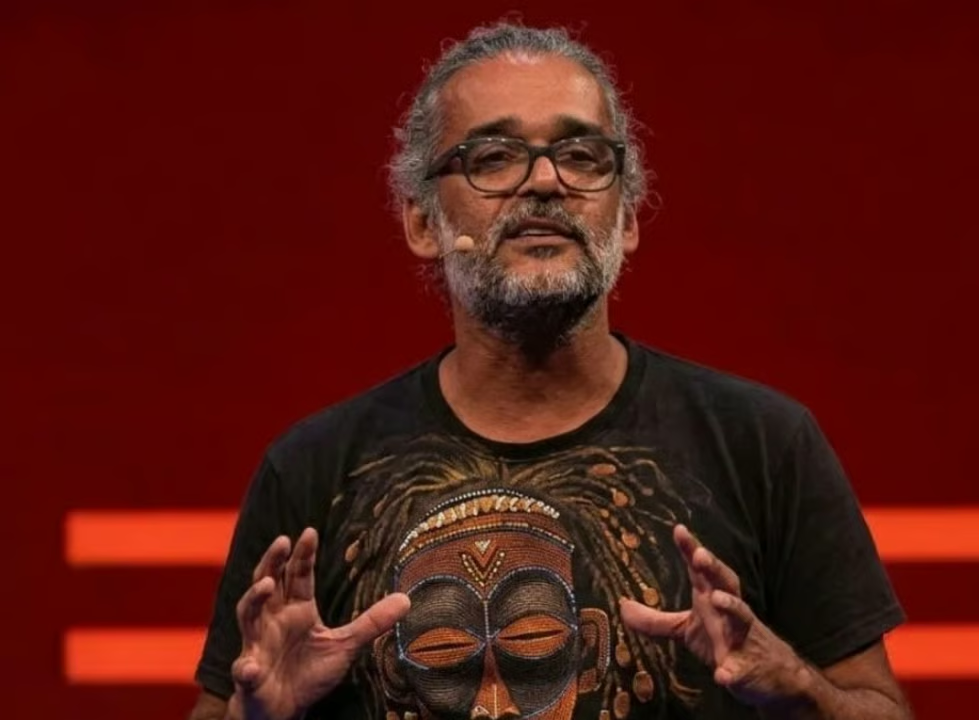
This is a translation of the Portuguese version published on this site, not a transcript of the original speech.
I was born in Angola in 1981, six years after we won our independence from Portugal and six years into a bloody civil war that was the last battlefield of the Cold War. That war would last until I was 21.
I am the eldest of five siblings. I have two brothers and two sisters. My parents separated when I was 2, and both worked ordinary nine-to-five jobs. So I spent most of my time with my grandmother. She is the most important person in my life and remains an inspiration to all of us. Today she is 96.
Growing up, my siblings and I had no idea we were living in a one-party socialist state. Of course I saw things, but I was too young to understand why certain things were the way they were. Like, what were all those Russians and Cubans doing there? The ongoing war, the power cuts and everything that was bad… well, the blame was simply put on the rebels.
When communism finally fell, the change was very abrupt. Fortunately, my parents always encouraged me to think outside the box, to ask hard questions and to look for my own answers. I also come from a long line of free thinkers and rebels.
My political awakening came when I started listening to a local hip-hop group called… Coligação. It was an openly political and completely fearless group. I quickly realised that our party-state, the MPLA, and its leader José Eduardo dos Santos had a problem.
The Arab Spring was a turning point. Seeing people power topple long-standing dictators in North Africa inspired us deeply. Soon afterwards, we began helping to organise the first big protests in our country, calling for dos Santos to step down. And although we were systematically arrested, beaten and violently attacked, we managed to make Angolans less afraid of the armed police and to plant in them the seed of fighting for their rights.
In 2015, the party-state came after us after I and 16 other activists organised reading sessions and debates on Gene Sharp’s book, “From Dictatorship to Democracy”. Somehow they decided we were preparing a revolution or a coup, and so we were arrested.
They took me to a maximum-security prison 100 kilometres from the capital, with a bag over my head, and threw me into a two-by-two-metre isolation cell, where I sometimes spent 47 hours without seeing daylight.
It was clear they were trying to break me, but instead I became more determined. First I refused to eat their food and, after three months, I began a hunger strike to protest against the illegality of our detention.
On day 19 I was hospitalised and I really thought I was going to die, so I wrote a letter asking not to be resuscitated if I fell into a coma.
That was when I realised that my hunger strike and our case were being talked about across the country and around the world. People who never usually spoke about human rights were speaking.
International pressure really made a difference. From the US State Department to the European Union, the Vatican and international human rights organisations — they all put pressure on the government.
The news from abroad gave us the courage to find creative ways to protest against our imprisonment and the unfair trial, because the world never stopped talking.
We were released less than a year later. Shortly after our release, dos Santos, who had been president for 38 years, finally announced he was stepping down. It was a relief.
But we knew his hand-picked successor, João Lourenço, would never change the system. And he didn’t. Still, for a brief moment, we felt a little freer. He even invited activists to a meeting at the presidential palace.
But that moment of openness passed, and the party-state came back with new forms of control, using the law to limit free thought, obstruct protests, restrict NGOs and criminalise dissent.
Angola rarely makes the news, even though it is constantly among the worst countries in the world for corruption, malnutrition, education, child mortality — you name it.
We don’t have a war, but people suffer as much as in better-known failed states. And this is a failed state by design.
Since 1975, the elite has squandered the country’s wealth, spending the people’s money on expensive and absurd propaganda campaigns.
In March, Will Smith came to Angola and met our leader to promote the country as a destination for tourism and the film industry. And help me out here: the 2026 Electric Boat World Championship — whatever that is.
Last year they spent 6 million dollars to bring Messi and the Argentine national team over for a football match.
Foreign governments have little interest in changing the status quo either, because they keep profiting. American and Chinese multinationals buy Angola’s oil and diamonds, but 50% of the wealth generated goes to paying off a 30-billion-dollar debt to China, because our leaders sold us out.
While governments profit, Angolans pay the price.
We see children as young as 7 searching for food in rubbish bins, children dying of preventable diseases in public hospitals, and more than 7 million people facing food insecurity — around 20% of the population.
Still, there are small things we can do to improve people’s lives. We have elections next year. Everyone knows they are rigged and do not reflect the will of the people.
We are trying to mobilise citizens to overcome their own apathy and take control of their destiny. We are trying to force the government to open up the electoral process and make it transparent.
We believe community radio can help with that goal. We also need money to pay the volunteer lawyers we work with, so they can help when people are arrested or abducted just for taking part in the electoral process.
And notice I said “when”, not “if”. Because it has happened before, it happened last time and it will certainly happen again.
Finally, we need journalists who are interested in Angola. Because we have seen — I have seen personally — the impact of international exposure.
We may not be able to change the party-state yet, but I still have hope for Angola.
Thank you for having us, Oslo.