Brain Drain and Macroeconomic Impact in Central and Western Africa
Translated from Portuguese. Read the original →

Migration dynamics within Portuguese-Speaking African Countries (PALOP) reveal deep macroeconomic and structural asymmetries. Recent analytical data uncovers a complex reality: while island economies and those in Western Africa suffer a massive, disproportionate loss of their most qualified human capital, Angola displays a paradoxical behavior. The country heavily dominates the absolute numbers of general emigration in the region, yet it maintains a comparatively contained brain drain rate (the loss of highly qualified professionals) when measured against its population size and productive capacity.
A Radiography of the Flows: Mass Emigration vs. Talent Retention
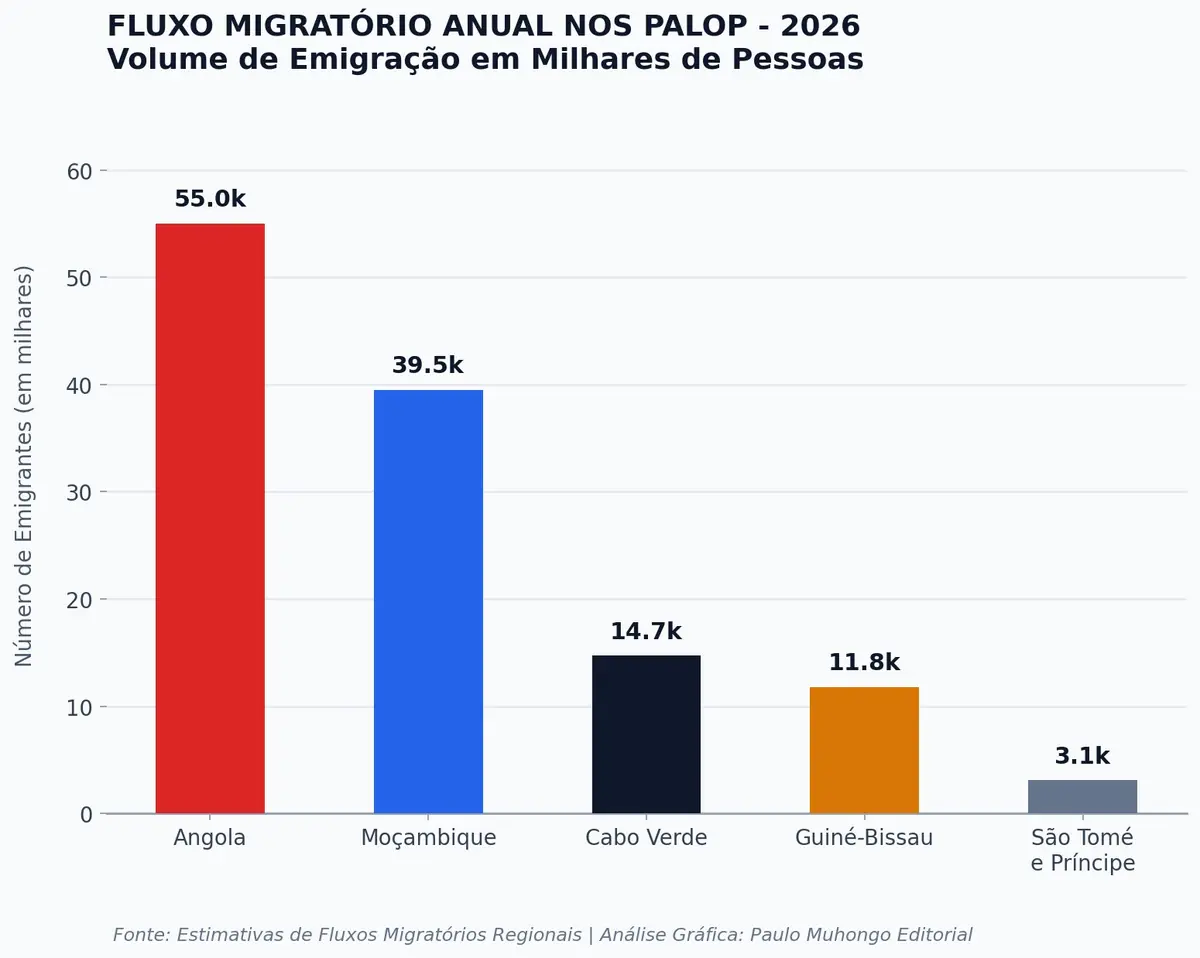
The statistical landscape of the PALOP highlights two distinct realities. On one hand, the overall volume of departures places Angola at the absolute top, with a projected flow of 55,000 emigrants annually, closely followed by Mozambique at 39,500. On the other hand, when the metric strictly evaluates the severity of highly qualified brain drain on a scale of 1 to 10, Cape Verde (6.7) and Guinea-Bissau (6.6) lead in terms of vulnerability, whereas Angola stands at a lower tier with 5.5 points.
This analytical divergence demonstrates that the vast majority of the Angolan migratory flow consists of unskilled or informal labor, pushed out by the loss of purchasing power and inflation in peripheral urban areas. In contrast, the country's core technical and professional class exhibits a much higher rate of domestic retention than its regional peers.
Why is the Brain Drain in Angola Relatively Low?
Unlike economies heavily reliant on services or with a deep-rooted tradition of academic diaspora, such as Cape Verde, Angola's economic structure retains its qualified personnel due to very specific market factors:
- The Extractive Sector and High-Yield Enclaves: The oil sector and associated mining industries operate as highly lucrative economic enclaves. Operating companies and service providers in Luanda offer salary packages, medical benefits, and incentives that far exceed the regional average in Sub-Saharan Africa. This ensures that engineers, geologists, and top managers maintain a standard of living they could hardly replicate as first-generation immigrants in Europe or North America.
- Concentration of Structural Public Employment: The Angolan state remains the largest employer of technical professionals, absorbing graduates in administration, law, and higher education. Access to positions within the state apparatus offers institutional stability and social status that act as a natural barrier against mid-career departures.
- The High Cost of International Recognition: Unlike Guinea-Bissau or Cape Verde, which possess academic equivalence bridges and well-established professional migration networks with the European Union, Angolan graduates face heavy bureaucratic hurdles and financial costs to validate their degrees abroad. This lowers the rate of strictly professional legal migration.
Social Warning: The Fragility of the Numbers
Although the brain retention rate in Angola is higher than that of its West African neighbors, this balance is highly precarious. Macroeconomic analysis warns that dissatisfaction among the professional middle class is rising due to the continuous depreciation of the Kwanza.
If the non-oil private sector is not revitalized through breaking monopolies, and if meritocracy does not replace political patronage in public administration, the country risks seeing its most qualified professionals join the mass migration stream. For now, the country utilizes its technical capital domestically, but it is managing a demographic pressure cooker that demands urgent reforms before the current equilibrium shatters definitively.