Angola and the Illusion of Growth: The Portrait of a Country Apparently Frozen in Time
Translated from Portuguese. Read the original →

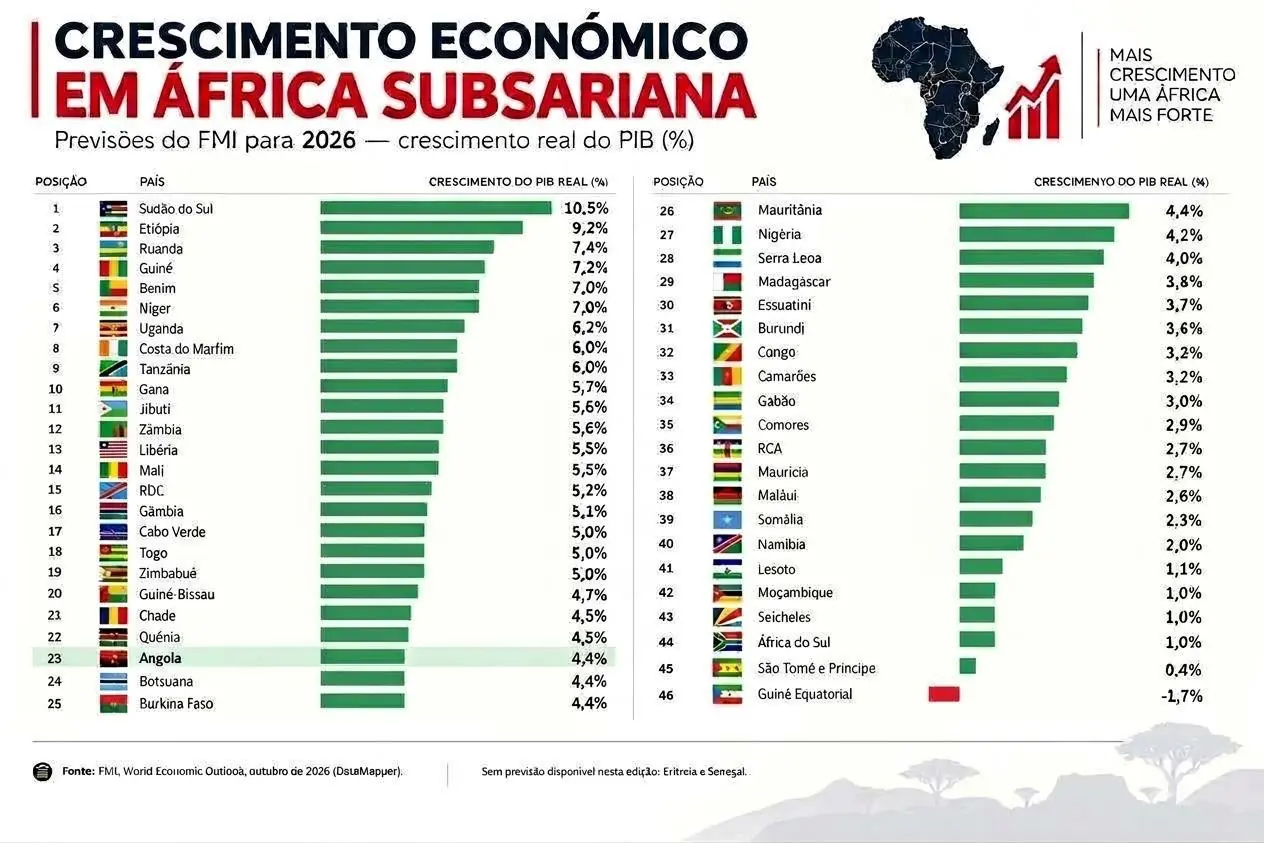
The recent forecasts by the International Monetary Fund (IMF) for 2026 place Angola once again in front of an uncomfortable mirror. In a chart where Sub-Saharan Africa displays dynamic recovery trends — led by South Sudan with an impressive 10.5% and Ethiopia at 9.2% —, Angola appears timidly in 23rd position, with a real GDP growth forecast of just 4.4%.
For a country that was once the economic engine of the region and one of the top destinations for foreign investment on the continent, these figures are not merely modest; they are the visible symptom of a nation that, structurally, feels as though it has stopped in time.
1. The Trap of Oil Dependence and the Failure of Diversification
The great Angolan paradox lies in the fact that the country remains hostage to the same economic model it inherited at the turn of the century. For over two decades, official rhetoric has repeated the catchphrase of diversification. However, the economic transition has never truly moved from political intent onto the ground.
While regional neighbors invest heavily in digitalization, large-scale agricultural modernization, renewable energy, and building ecosystems that foster entrepreneurship, the Angolan economy continues to contract and expand at the rhythm of oil price fluctuations on international markets. Analysis by leading financial media such as Expansão underscores that the lack of long-term monetary confidence makes private investment defensive and timid. When oil falters, the entire country paralyzes.
2. Deficient Infrastructure and the "Context Cost"
Standing still in time is also a literal reality in Angola when looking at the infrastructure network. Despite billions of dollars poured into concrete and post-war rehabilitation, the country still fails to deliver the basics:
- Energy and Water: Continuous irregular supply chokes any attempt at industrialization and drastically drives up operating costs for private enterprises.
- Logistics: Efficient connections between the productive areas of the interior and the major consumption hubs on the coast remain severely deficient.
This high context cost strips away Angola's competitiveness and deters high-quality foreign direct investment — the kind that creates sustainable jobs and transfers technology. Instead, capital prefers to settle in regional geographies with more predictable and modern business frameworks.
3. The IMF Warning: Fiscal Rigueur Without Social Impact
International institutions acknowledge Luanda's nominal efforts in fiscal consolidation and public debt management, which recently led agencies like Moody's to upgrade the country's outlook. However, this policy of "clean accounts" is executed at the expense of the base of the social pyramid.
The reduction of fuel subsidies and chronic underfunding of public services suffocate the purchasing power of the middle class and worsen precarity. A projected growth of 4.4% for 2026, against one of the highest birth rates on the planet, implies a mathematical certainty: the real impact on per capita wealth is virtually zero, and the majority of the population continues to grow poorer.
Conclusion: A Mandatory Strategy Reset
The 2026 forecasts serve as a stern warning. Angola can no longer manage the present using the worn-out formulas of the past. To stop looking like a frozen country, it must break economic monopolies, simplify a paralyzing bureaucracy, and place human capital, technical education, and domestic production at the heart of a genuine development strategy. Otherwise, Angola will remain the eternal country of the future, trapped in a present that refuses to move forward.