Between the Nile and the Red Sea: war has returned to Ethiopia
The renewed fighting in northern Ethiopia has broken the fragile peace reached in 2022, caused new displacement and deepened regional rivalries. While governments fight over territory, water and influence, it is once again civilians who pay the highest price.
Translated from Portuguese. Read the original →

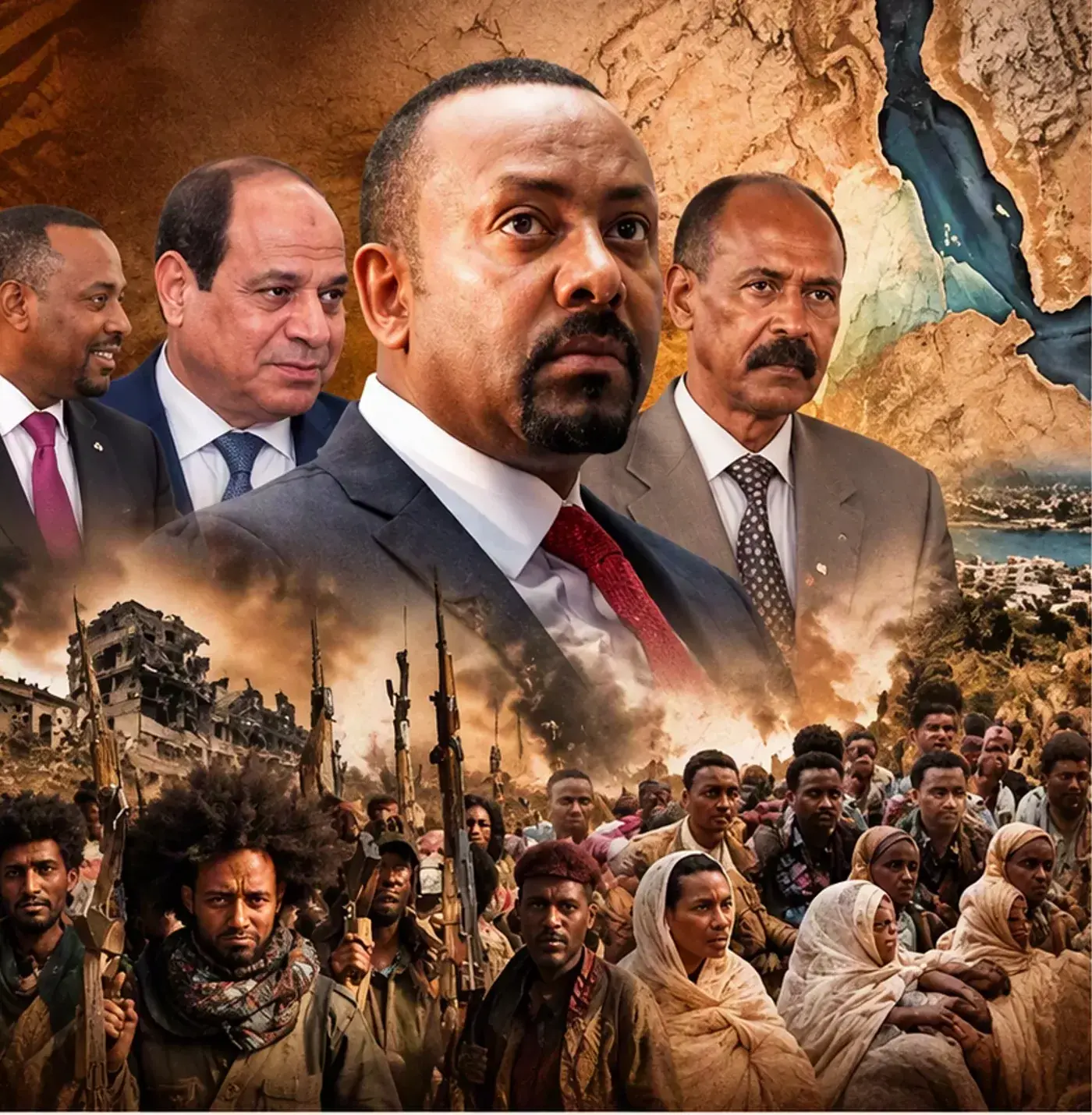
The fighting that broke out on 23 September between federal government forces and an alliance of armed groups, including the Tigray People’s Liberation Front, known as the TPLF, is the most serious military escalation since the end of the 2020–2022 war. Hostilities have reached the Tigray, Amhara and Afar regions, reviving fears of a prolonged conflict and a regional crisis with unpredictable consequences.
The military situation moved quickly. After rebel forces seized airports and advanced on several fronts, federal forces and their allies retook Mekelle, the regional capital of Tigray. The TPLF confirmed it had withdrawn from the city and announced that its administration would temporarily operate from elsewhere.
The government’s recapture of Mekelle does not, however, mean the end of the war. The rebel withdrawal may simply mark the start of a new phase of decentralised operations, sporadic attacks and prolonged instability in the northern regions.
A peace agreement that was never completed
The roots of the current crisis go back to the war that began in November 2020, when disagreements between Prime Minister Abiy Ahmed’s federal government and the TPLF turned into a devastating conflict.
For two years, Tigray was the scene of military operations, blockades, mass displacement and the destruction of infrastructure. The Pretoria Agreement, signed in November 2022 under African Union mediation, halted large-scale fighting, but several fundamental questions remained unresolved.
Among them were the status of the disputed territories, the return of displaced people and the disarmament of Tigray’s forces. In July 2026, the TPLF declared that the agreement had, in practice, collapsed. The federal government rejected that interpretation and said it remained committed to the peace process.
The failure to implement the agreement in full left room for forces to regroup, for political divisions to deepen and for military logic to return.
This is one of the main lessons of the crisis: signing peace is not the same as building it.
Afar and the return of displacement
The humanitarian impact is once again being felt far beyond Tigray.
At the end of September, a humanitarian source estimated that at least 150,000 people had been displaced in the Afar region alone, although limited communications and access made an accurate count impossible. The same source warned how hard it was to gauge the true scale of the emergency.
Communication blackouts, road closures, insecurity and the proximity of the fighting make it hard for humanitarian aid to get through. For thousands of families, fleeing means leaving behind homes, farmland, livestock, schools and livelihoods.
Behind every military map there is a family torn apart. Behind every conquered territory there is a village that no longer produces food. Behind every political statement there are children who have lost access to school, health care and safety.
In Shire, a 32-year-old driver described the return of war as deeply painful, recalling that Tigray’s population has still not recovered from the previous conflict. His testimony reflects a widespread feeling: for many residents, the new offensive is not just another political crisis, but the return of a trauma that never went away.
Accusations that cross borders
The conflict quickly stopped being a purely internal dispute.
The head of Ethiopia’s armed forces accused Eritrea, Egypt and Sudan of supporting the armed groups fighting the federal government. All three countries denied any involvement.
These accusations must be reported with caution. In a conflict marked by propaganda, restricted access and severed communications, a political allegation is not the same as verified evidence.
The deterioration of diplomatic relations, however, is clear. The military confrontation inside Ethiopia is intersecting with long-standing disputes over borders, regional alliances, the use of the Nile’s waters and access to the Red Sea.
The risk is that a war initially fought within Ethiopia’s borders becomes a proxy conflict, fuelled by outside interests and accumulated rivalries.
The Alamein Declaration
On 4 October, the leaders of Egypt, Eritrea, Somalia and Sudan met in New Alamein, Egypt.
The summit was attended by Egyptian President Abdel Fattah el-Sisi, Eritrean President Isaias Afwerki, Somali President Hassan Sheikh Mohamud and the head of Sudan’s army, Abdel Fattah al-Burhan.
In their joint declaration, the four countries upheld respect for the sovereignty and territorial integrity of states, the principle of non-interference and the peaceful settlement of disputes. They also agreed to set up a permanent follow-up mechanism and to hold further periodic consultations.
On the Red Sea, they declared that its governance should remain the responsibility of the coastal states. On the Nile, they called for compliance with international law, prior consultation and the rejection of unilateral measures that harm current water uses in Egypt and Sudan.
The declaration did not name Ethiopia directly, but it addressed two issues central to Addis Ababa’s strategic interests: the management of the Nile’s waters and Ethiopia’s ambition to secure stable access to the Red Sea.
Addis Ababa’s response
On 5 October, Ethiopia’s Ministry of Foreign Affairs reaffirmed the country’s interests in the Blue Nile, known locally as the Abay River, and in the Red Sea.
The statement declared that the region’s geographical and historical realities cannot be changed by political pressure, coercive measures, destabilising actions or aggression carried out through proxies. At the same time, Addis Ababa said it favoured an approach based on dialogue, mutual respect, regional cooperation and good-neighbourly relations.
The response shows that the dispute goes beyond the military field. At stake is a competing vision of the regional order: who may take part in decisions on the Red Sea, how the Nile’s resources should be managed, and how far each state’s sovereignty can extend when its choices affect its neighbours.
The dam at the heart of the rivalry
The Grand Ethiopian Renaissance Dam, built on the Blue Nile, remains central to the tension between Ethiopia and the downstream countries.
- EthiopiaHighlands where the Blue Nile (Abay River) rises. According to Addis Ababa, about 85% of the Nile’s flow.
- Grand Renaissance DamOn the Blue Nile, in Ethiopian territory.
- SudanDownstream country.
- EgyptDownstream country, dependent on the Nile.
- The New Alamein fourEgypt, Eritrea, Somalia and Sudan: governance of the Red Sea should belong to the coastal states.
- Ethiopia, landlockedSince Eritrea’s independence. The nearest point of its border lies about 48 km from the coast, according to Ethiopia’s foreign ministry.
For Addis Ababa, the dam stands for development, energy production and the assertion of its right to use the natural resources within its territory. For Egypt and Sudan, any unilateral management of the river could affect current water uses and the security of the populations that depend on the Nile.
Ethiopia maintains that almost all of the Blue Nile rises in the Ethiopian highlands and that this river contributes about 85% of the Nile’s total flow. The Ethiopian government believes this reality should be recognised in negotiations on the use and management of the water.
The problem is not only technical. It is also historical, economic and political.
The Nile is at once a water source, an instrument of development and a symbol of sovereignty. As long as each country treats it solely as national heritage rather than a shared resource, any disagreement may be read as an existential threat.
The Red Sea and the ambition of a landlocked country
Ethiopia lost direct access to the sea after Eritrea’s independence and became a landlocked country. Even so, Addis Ababa maintains that its population, geographical position and proximity to the Red Sea give it legitimate interests in regional maritime security.
Ethiopia’s Ministry of Foreign Affairs pointed out that the nearest point of the national border is about 48 kilometres from the coast, and argued that any serious debate on the Red Sea’s security architecture must take the country’s interests into account.
On the other side, the four countries gathered in New Alamein stated that governance of the Red Sea should belong exclusively to the coastal states.
These positions reveal a strategic incompatibility that will not be resolved through intimidation or military alliances. Ethiopia cannot ignore the sovereignty of the coastal states, but those states cannot treat Ethiopia’s economic and security interests as if they were irrelevant either.
No country can win alone
The Nile, the Red Sea and the borders inherited from history are not political trophies. They are lifelines shared by millions of people.
No country can guarantee the security of the Nile on its own. No state can control the risks in the Red Sea by itself. No government will be truly stable while neighbouring populations live surrounded by war, hunger and displacement.
Alliances built against a neighbour may bring short-term diplomatic advantages, but they also deepen the sense of encirclement and shrink the room for compromise. Likewise, insisting on unilateral decisions increases mistrust and brings the region closer to confrontations that could be avoided.
In the Horn of Africa, security will not be sustainable as long as it is understood as the insecurity of the other.
A possible path to peace
A lasting peace requires more than retaking cities or signing new communiqués. It requires a political process capable of tackling the causes that allowed war to return.
That path must include:
- a verifiable ceasefire between federal forces and the armed groups;
- safe and unhindered humanitarian access to affected populations;
- protection of civilians and essential infrastructure;
- an independent investigation into allegations of foreign military support and into violations committed during the fighting;
- effective implementation of the outstanding provisions of the Pretoria Agreement;
- direct dialogue on the disputed territories, the return of displaced people and disarmament;
- regional negotiations on the Nile and the Red Sea;
- African mediation with legitimacy, independence and the capacity to follow through.
The African Union must be at the centre of this process, but African leadership cannot be just a diplomatic formula. It needs resources, access to the parties, verification mechanisms and international support that does not replace the will of local actors.
Nor can peace be negotiated only between presidential palaces, military commands and foreign governments. It must include displaced communities, local authorities, humanitarian organisations, civil society representatives and the populations directly affected.
The choice facing the Horn of Africa
Retaking Mekelle may shift the military balance, but it does not resolve the political divisions fuelling the conflict.
The previous war showed that it is possible to conquer cities without conquering trust. It also showed that a military victory does not erase historical grievances, community resentments or territorial disputes. It only postpones them.
The region’s leaders now face a choice. They can keep turning the Nile, the Red Sea and borders into instruments of rivalry. Or they can recognise that none of these resources brings security when it is used to exclude, pressure or weaken a neighbour.
Until that choice is made, it will once again be families, farmers and children who pay for decisions taken far from their homes.
Peace in the Horn of Africa will not be born from alliances built against one country. It will be born from honest dialogue, humanitarian access, independent verification of the accusations, implementation of existing agreements and African mediation that treats every party with dignity.
Sources
Al Jazeera; MENA, Middle East News Agency (New Alamein Declaration, 4 October); statement by Ethiopia’s Ministry of Foreign Affairs (5 October).