Chapter I: Between the Loneliness of the Streets and the Chaos of Life
Translated from Portuguese. Read the original →

Today, I awoke to the first rays of sunlight, timid travellers slipping through the cracks around the kitchen window, spilling golden light over the morning gloom. Driven by the desire to witness the unrepeatable spectacle of each dawn, I approached the glass. My gaze stretched beyond the window, reaching the vastness of the Tagus, where the restless waters reflected a sky still asleep. Further away, a wild field breathed in the freshness of the dew, its shrubs blooming with every whisper of rain, in a silent invitation to the life nestled there.
As I opened the window, a morning breeze, carrying the scent of wet earth and fresh grass, kissed my face, still heavy with sleep. In the air, birds hidden among the branches sang their ode to the rebirth of the day. It was as though every note of their symphony carried the silent promise of a spring about to blossom. On the clear horizon of the Lisbon I love, the sun painted strokes of light, heralding new stories and new destinies waiting to be discovered.
I sat on the windowsill, surrendering myself to that fleeting moment of peace. With my eyes closed, I filled my lungs with the fragrance of the morning, as though I wanted to imprison the pure essence of that moment within me. Lisbon was blossoming in all its magnificence, and there, suspended between dream and reality, I was awakened by the distant murmur of a city that never sleeps. It was routine, that old sentinel, calling me back to the rhythm of everyday life. Duty was lurking, and I, a prisoner of the social machinery, could not ignore its call.
As I left home, wrapped in the mildness of the weather, I stopped at the corner café, where the morning grew dense with murmured conversations and the aroma of freshly ground coffee. With the serenity of someone prolonging the minutes before the inevitable, I sat on the terrace, watching the sun tentatively tear through the clouds and make the liquid surface of the Tagus shimmer. I savoured a pão de Deus sandwich as though it were a sacred ritual, the cheese and ham melting together beneath the gentle warmth of the butter, while a steaming galão and a glass of orange juice brought the quiet sweetness of the morning to my palate.
My eyes wandered across the bustle of the streets. Children grumbled as they were dragged off to school, echoing my own childhood days, when my mother, sweet Oga, hurried me through the narrow lanes so that I would not arrive late. I then lost myself in the silhouette of a woman passing by. Her face, blurred by distance, carried the ancient grace of times that would never return. The elegance of her movements and the dignity of her clothes evoked an era when modesty was a rare jewel, guarded with the same devotion with which monks watched over their sacred temples.
Time, however, did not stop for me. The clock kept moving, and the screen of my phone displayed a Google Maps notification announcing that my bus would soon arrive. I swallowed the last remnants of my breakfast, paid in haste, and ran to catch the 759. It arrived with its usual urgency, gliding along the road as though trying to recover lost minutes. On board, I was jolted by the bumps that make up the daily choreography of Lisbon's public transport. My destination was Santa Apolónia station, where the metro awaited me, ready to swallow another passenger into the morning rush.
At the Terreiro do Paço stop, a mother and her son boarded. The little boy, his face creased with sleep, found himself separated from his mother by the occupied seats. I immediately stood up and offered him my seat, for it always saddens me to see a child separated from a mother's warmth, even for a few brief moments. It was not long before the boy burst into tears, while his mother, with gestures that were both tender and firm, wiped his sore nose. With a gentle kiss and whispered words, she brought him comfort and peace, reminding me, in a flash of nostalgia, of the days when my mother's arms were my safe harbour. Longing pierced my chest, and a tear rolled down my cheek. Ten years have passed since I last saw her.
When I came to my senses, I was at Marquês de Pombal. The world had regained its pulse, and I, like everyone else, was absorbed into the machinery of the day. I walked for seven minutes to the office, where, upon entering, I greeted the security guard, who returned my greeting with a smile of old-fashioned courtesy. Work awaited me, as predictable as ever. Small variations in procedures, but a core that remained unchanged, immovable. They say we are the most advanced generation of all time; yet I wonder whether, paradoxically, we might also be the most lacking in imagination.
Even so, I find some comfort in what I do. Faces cross paths, stories intertwine, and every now and then a glimpse of humanity escapes from the gears of the system. But monotony is unavoidable. For eight hours, I move like an automaton, immersed in predictable tasks, while the realm of imagination is silenced by the demands of reality.
But is resisting really worthwhile? Would changing jobs simply mean moving to another cell in the same prison? We deceive ourselves with the idea of freedom, yet we live chained to rent, bills, and obligations. Some days, I envy primitive man, who, without a fixed home or restraints, made the world his dwelling. He migrated when he wished and hunted when he was hungry. And we, at the height of civilisation, what do we have? A freedom drawn with ruler and set square, always limited by the price we pay to exist.
As I left the office, I decided to reject the underground belly of the metro and surrender myself to the streets of Lisbon, allowing my steps, long imprisoned beneath a desk, to rediscover the freedom of the asphalt. I walked for twenty minutes, passing Restauradores and the elegant Rossio railway station, until I emerged into Largo de Martim Moniz. There, beneath the indifferent gaze of the hurried city, groups of young Africans, Indians, and Nepalese gather, newly arrived not only in Lisbon but also in an endless wait. Without documents or a fixed address, they occupy their time as best they can, waiting for the elusive promise of an opportunity.
Beneath makeshift tarpaulins and on the cold pieces of cardboard that shelter them when night closes in, silence tells stories that the city pretends not to hear.
For a moment, I considered taking tram 28, but when I saw the mass of tourists gathered at the stop, I opted for a small bus that follows the same route without fanfare, a secret shared only by those who know Lisbon as they know an old friend. I got off on Rua da Penha de França, where the voices of religious ceremonies rise towards the heavens.
After the service, I remained by the entrance for a few moments, breathing in the night air, when, in a casual gesture of courtesy, I greeted two women. And it was there that fate, always ready to surprise us, began weaving a new chapter. One of them radiated extroversion; the other was all shadow and silence, wrapped in a natural reserve that made her even more intriguing. Amid words and laughter, a sense of warmth blossomed, and, without ceremony, I invited them to dinner accompanied by fado music. Their “yes” rang out like a promise, and within moments we had called an Uber and set off towards the Fado Museum.
The driver, a man with tired eyes but a sharp mind, turned out to be a storyteller. Once employed by one of the city's largest accounting firms, he had lost his position because of the pandemic and had been forced to reinvent himself behind the wheel. “Life is a wave that forms and breaks apart without warning,” he murmured. His words brought to mind the reflections of the great sage Solomon, reminding me of Ecclesiastes 9:11:
“The swift do not always win the race, nor do the strong always win the battle… time and unforeseen circumstances overtake them all.”
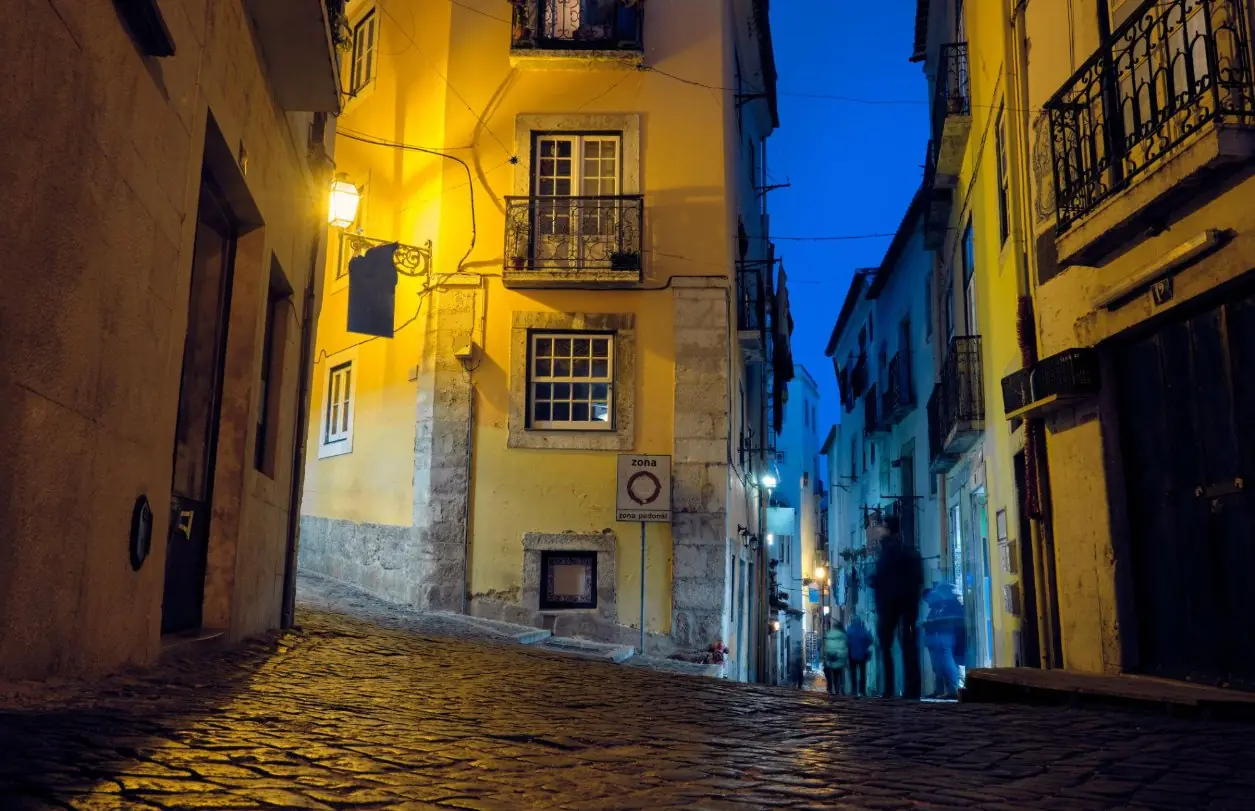
The conversation drifted between nostalgia and acceptance, while Lisbon, young and beautiful, glowed outside, its lights stitching the banks of the Tagus together. When the car dropped us off in Alfama, we walked like characters in a fado song yet to be composed. It was 11:45 p.m., and the city was gradually falling asleep, while the glow of the candles at Santa Luzia faded in the distance. Rather than give in to the first restaurant that called out to us, we decided to lose ourselves in the intricate weave of narrow streets, climb hills, and descend stone stairways polished by time, breathing in the ancient soul of Lisbon.
In the half-light of Alfama, fado no longer echoed as it once had. Few establishments remained open, and in those that did, fado singers gave voice to the sorrows of the world through notes that seemed carved from destiny itself. Surrendering to exhaustion and late-night hunger, we chose one of these establishments, where the red and white tablecloths contrasted with the solemn black worn by the waiters and performers. The service was attentive, the prices high, but the experience was worth every cent.
We savoured shrimp sauce and bread while a red wine warmed the words we exchanged. We surrendered ourselves to the enchantment of the melodies, allowing fado to guide us along paths of saudade, that deep longing so intimately connected with the Portuguese soul. With every note, the audience's silence became part of the music, a profound expression of respect for the emotion carried by the strings and the voices.
Yet, amid the verses of the night, something caught me off guard. The French ladies, between one sip of wine and the next, confessed that Lisbon seemed excessively hectic to them. I was astonished. To me, Lisbon is one of the last cities where life still pulses with authenticity, where hospitality is etched on every face, and where one can eat well without having to sell one's soul to luxury. But instead of contradicting them, I accepted their perspective as one accepts the diversity of the ways people see the world. After all, beauty lies in the uniqueness of each experience.
When the fado fell silent, I felt that the moment called for something more. The streets beckoned, and we made our way to the Miradouro da Senhora do Monte. Beneath the stars, Lisbon stretched out before us like a carpet of trembling lights. I knew the night was slipping away, and with it, that chance encounter.
The farewell came without invitation. I walked them to the Rossio metro station and, without exchanging contact details, preserved the untouchable nature of that moment. Could I look for them on social media? Yes. But why dilute the enchantment in a sea of fleeting messages? I preferred to keep that night as a memory that time could never touch.
In its mysterious unpredictability, Lisbon had given me a night of enchantment and anticipated longing. And so, as I returned alone in the early hours, I understood that some encounters should remain where they happened, like notes suspended in the air before the final chord fades away.
The next day, the first of July dawned over Lisbon, splendid and radiant. The sun, in its infinite gentleness, glided softly across the faces of passers-by, bathing the city in golden light that shimmered on the old façades. By one o'clock in the afternoon, the terraces of cafés and restaurants were bustling with life, filled with wandering souls from every corner of the world, each carrying stories, dreams, and disappointments.
Yet I was not fortunate enough to find an empty seat in any of these outdoor havens, not even in that small Italian restaurant where I had so often nourished both body and spirit. But there is another place, a silent sanctuary that never denies me shelter, whether in times of abundance or scarcity. As I cross the threshold of this faithful restaurant, I feel myself withdrawing from the curious glances dancing outside, dissolving into the restaurant's shadows while the brightness of the day remains beyond the door.
The waiter, always attentive, welcomes me with a warm smile and leads me, without needing a word, to my usual table. And, as though chance were weaving secret encounters between the shores of the unexpected, I discover an old colleague at the next table: Dr Gustave, a man distinguished not only by his extensive knowledge and refined spirit, but also by an elegance rarely seen in an age when youth seems orphaned of refinement.
He is one of the few who still preserve the art of presenting oneself well: meticulously arranged hair, impeccably ironed clothes, gleaming shoes. He stands in striking contrast to so many others, who dress as though they had just emerged from a forgotten trunk, with shoes so grimy that their original colour can no longer be distinguished.
Jokingly, I often say that we live in the age of dirty shoes. Once, I crossed paths with a young university student whose outfit suggested that he was on his way to defend his thesis or deliver some important presentation. At first, his appearance was impeccable, until my eyes settled on his worn-out backpack and filthy trainers. At that moment, I felt a shiver of discomfort, as though the disorder in those details betrayed the entire intention of elegance.
The waiter approaches, attentive and ready to take my order. I do not hesitate. I ask for a jug of the house red wine, a well-deserved toast to the unexpected joy of this reunion. Giving myself over to the lightness of the moment, I leave the choice of lunch to the waiter. He suggests pork chops with potatoes. I nod, not particularly interested in the meal, as I already feel satisfied by the lively conversation and the memories dancing between us.
The son of an Angolan woman, Dr Gustave carries a deep affection for that land in his eyes, along with a constant concern for its future. As in so many previous encounters, we plunge into lengthy reflections on what an ideal Angola might look like, tracing possibilities within the limits of our vision. We talk about literature, wander through scattered thoughts and, even without intending to, eventually touch upon the harsh realities of working life.
With sadness, I listen as he describes the company where I once worked as an insatiable machine, driven solely by profit, where the humanity of its workers dissolves into the merciless machinery of quarterly earnings. I share his disillusionment, for I know all too well this familiar tune of exhaustion and alienation, this cruel rhythm that reduces human beings to mere numbers.
At the height of our conversation, already shrouded in a haze of discouragement, my phone vibrates. An unknown number appears on the screen. I answer hesitantly. On the other end, a sweet, familiar female voice says in an almost playful tone:
“It's the police.”
I frown, puzzled.
“The police?” I ask, a mixture of astonishment and suspicion in my voice.
But before doubt can take root, the answer arrives with an audible smile:
“No, it's Elisabeth.”
At the sound of her name, a shiver runs through my body. Intense joy mingles with an unexpected sense of awkwardness. I had never imagined this reunion. The French ladies, with whom I had shared moments of laughter and light-heartedness, invite me to go out that evening. They insist on paying for everything.
For a moment, I hesitate. I know the French sense of pride and understand that they do not want to feel indebted to anyone, not even God. I almost perceive this gesture of gratitude as an insult, but the desire to see them again, to prolong a story that is still unfinished, speaks louder. I set aside any futile resistance and accept the invitation.
We say goodbye with an “see you later”, and when I hang up, I meet Dr Gustave's attentive gaze.
“Who was that?” he asks curiously.
I briefly tell him the story of the women who crossed my path and the pleasant hours I spent in their company. He bursts into laughter, patting me on the shoulder.
“There you have it, Dom Carlos! Life only has value when it is shared. These fleeting encounters that Lisbon offers us are like breaths of oxygen in the middle of routine.”
I nod in agreement.
“The absolute truth, my friend.”
But Lisbon, however generous it may be with its moments of freedom, does not spare us the merciless call of reality. Time runs out, and the system that governs our days summons us back, pulling us into its labyrinth of obligations.
We part with a firm embrace, and Dr Gustave goes on his way. I remain for another moment, contemplating the empty table before me, until the waiter approaches and tries to start a conversation. His words, although spoken in Portuguese, reach me like a distant murmur, impossible to decipher.
I smile.
He persists, pointing towards a woman sitting to my right, but my mind remains clouded, unable to understand. To avoid any embarrassment, I keep smiling. After all, sometimes a smile is enough to sustain the fragile balance between two strangers.
I take leave of the waiter with one final nod and return to the reality awaiting me: a daily life shaped by eight long hours of work, where my salary barely covers the rent and little else.
For now, however, I carry with me the lightness of this day, the echoes of my conversation with Dr Gustave, and the promise of a reunion that evening. And perhaps, just perhaps, that is enough to keep going.
At the end of the day, an irresistible impulse takes hold of me. I leave the office, eager to savour the last breaths of the afternoon. I refuse to be swallowed once again by the whirlpool of bodies jostling on the metro, on buses, or in cars winding through the streets like an endless river. I seek a delicate balance between movement and contemplation, between haste and pleasure.
I let the fresh air envelop me as I cycle down Avenida da Liberdade, that pulsating artery of Lisbon where the generous shadows of trees draw arabesques across the pavement, silent witnesses to the city's bustle. I pedal peacefully, and the small gardens opening along the route resemble aquariums of beauty, green refuges that bring a smile to my face.
At Restauradores, I pause briefly. I contemplate the sculptures resting there, immortalising in stone the memory of an iconic name. I continue towards Rossio, where the railway station rises like a fairytale castle, a dream carved into time. Every detail of its façade shines beneath the afternoon's golden light, making me feel as though I am standing before a vibrant canvas where history and art intertwine like a living painting.
At Armazéns do Chiado, I park my bicycle and go inside. I cross the space with light steps, like someone revisiting memories. I approach the old café, now enveloped in the global atmosphere of an American chain, yet still preserving the whispers of another time. I choose a table by the window overlooking Rua Nova do Almada. I order a hot chocolate and let its sweet aroma envelop me. Outside, the ebb and flow of people create a mosaic of cultures, a living portrait of Lisbon in all its plurality.
On the varnished wooden benches, resilient in the face of time and change, I see the persistence of the past. I wonder what allows them to endure. The answer comes to me like a whisper: they are links between what we were and what we are, anchors for those searching for meaning in the traces left by time.
Here, my soul finds rest, lulled by sensations and daydreams. Inspiration, inevitably, leads me to write a poem:
Between Verses and Enchantment: The Symphony of the Soul
From you comes the symphony that cradles my days,
Melodies dancing between the breeze and the half-light,
Dressed in spring or wrapped in winter.
From you, I forge immortal memories,
Fragments of enchantment that defy time,
Stories that will vibrate in the eyes of the future,
Like echoes intertwined in the firmament.
Here, where the window opens onto Rua Nova do Almada,
I give life to verses unfolding like flowers in full bloom,
Chronicles and prose, sometimes intoxicated with laughter, sometimes with pain,
Reflections of eternity pulsing in every emotion.
Thus, with ink made of longing and a pen made of hope,
I write the poem of existence, intertwining souls,
To the measure of time, to the rhythm of the universe,
Raising verses that become eternal like a divine hymn.
I leave Armazéns do Chiado and climb towards Largo do Chiado, where Lisbon breathes memories and secrets. Amid the crowd stands the sculpted figure of Fernando Pessoa, whose presence is now immortalised in bronze, just as it once was through his verses. Tourists approach, vying for the privilege of sharing his table and freezing in photographs a moment they believe to be eternal. Behind him, A Brasileira radiates timeless charm. The interior glows beneath warm light, but it is on the terrace that everything happens. Here, in the heart of Lisbon, life pulses to the rhythm of hurried footsteps and lively conversations.
Near the statue of António Ribeiro Chiado, a street musician plucks Latin melodies, scattering notes that settle into the air as though they were part of the city itself. The chords fill the space, and for a moment all worries dissolve into the harmony of sound.
A female voice rises from the crowd, singing a song with warm rhythms. The audience hesitates, held back by the fear of exposing themselves to the gaze of others. But then an elderly man breaks through the circle, dancing with a lightness that defies time. Shortly afterwards, his beloved joins him, and the enchantment is complete.
Like a fuse catching fire, courage spreads. Women pull their partners towards the centre, laughter mingles with the chords, and even the city seems to pulse to the rhythm of the music. Among the impromptu dancers, a child rehearses their first steps, balancing innocence and rhythm. The moment is pure, fleeting, and unforgettable: an instant in which time pauses to celebrate life.
As I walk down Rua do Alecrim, I stop for a few moments. The Tagus reveals itself in the distance, a mirror of blues and golden reflections. Some things in life, I realise, reveal their true charm only when viewed from afar. But the honking of a car pulls me out of my thoughts, and I continue towards Cais do Sodré. There, I sit on the quay, watching boats cut through the waters, carrying dreams and destinies. With every departure, the waves stir, the ground seems to move, and the air fills with murmurs and farewells. For a moment, everyone follows the boat with their eyes until it disappears over the horizon. Yet the hope of its return always remains.
When I finally come back to myself, it is time to make my way to the ladies at the place that has remained etched in our memory as the scene of our farewell: Rossio metro station. While still some distance away, I catch sight of my two beautiful companions, dressed casually. I greet them with the utmost delicacy and respect. I myself, however, am dressed formally, since I have come straight from work. I therefore suggest that the French ladies stop by my home so that I can change clothes. They agree, and we take a taxi to my house, thus escaping the afternoon's scorching heat.
At home, while I get ready, they listen to classical music, perhaps not by choice, but because it is the first selection that appears when they access my Spotify account. Elisabeth does not hide her displeasure with the music, saying that it makes her sleepy, while Raquel, as always, remains silent, keeping her feelings, emotions, and opinions to herself.
As we share these moments, I delve ever deeper into the intricate layers of the personalities of these two singular women. Elisabeth, with her extroverted character and a touch of naivety, never states anything with absolute certainty. Yet it is precisely this charming naivety that makes her irresistible. Getting to know her is like sailing across a serene ocean, where gentle winds blow, carrying the exotic fragrances of a distant garden. In her presence, I find a calm that soothes my soul and awakens genuine joy.
Raquel, on the other hand, is reserved by nature, a woman of restrained gestures and rare words, spoken only when the occasion demands them. There is a silence within her that is not empty, but full of hidden meanings, a mystery that gradually reveals itself, awakening an unrelenting curiosity in me.
Unravelling her is like turning the pages of a long-awaited book, each page revealing unexpected nuances. Getting to know her is like embarking on an uncertain voyage, sailing across unknown seas where the horizon is ambiguously drawn, sometimes shadowy, sometimes fascinating. And with every step forward, the desire to decipher her mysteries only grows stronger.
In a hurry, we leave the house and make our way to Rua da Santa Polónia, where Ferroviário is located, a bar with a bright atmosphere and a magnificent view of the Tagus. We walk for about seven minutes before arriving, where the waiters welcome us warmly. The waitress who serves us is extremely kind and provides impeccable service. I choose a mojito, while the ladies opt for a strawberry and raspberry smoothie. By mutual agreement, we decide to order a platter of appetisers, a true feast for the senses. The platter contains a variety of ingredients, including cheeses, cured ham, cooked ham, fresh grapes, raisins, figs, honey, bread, and other delicacies that make our mouths water in anticipation.
As we savour the appetisers, my gaze turns towards the ladies, whose faces radiate a dazzling brightness. They seem like two little stars illuminating the path of a lonely fisherman lost in the vast ocean in his humble canoe. Beauty and fragrance seem to emanate from their smiles, and I feel somewhat dazzled, unable to decide which of these images to fix my eyes upon. We capture that moment not only on our phones but also in our memories, as a precious keepsake. For one fleeting instant, I feel in love with the two women before me, each with her own uniqueness, her own special touch, each having touched my heart in a different way.
Initially, we intended to have dinner at a restaurant after the aperitif. However, the appetisers prove so refined and satisfying that we feel completely full, leaving room only for dessert. The ladies are eager to visit the Fábrica dos Pastéis de Nata, near the Restauradores metro station, to taste these wonderful sweet pastries. Without hesitation, we head to Santa Apolónia metro station, board a train, and travel to Restauradores. At the pastry shop, they savour the delicacies with delight. As for me, I choose not to order anything, but Elisabeth insists that I try something. To please her, I order an Água das Pedras sparkling water with lemon, whose refreshing taste revitalises me and helps with digestion.
As the night advances, silence settles over the streets. Bars and restaurants close one after another, making it clear that the time for our farewells has arrived. Yet my deepest wish is for that unique moment to continue indefinitely, so I keep walking with them towards the hotel where they are staying. Along the way, we encounter a young man with whom I have been discussing the true essence of life for many years. My two guests do not hesitate to share their thoughts with him and encourage him to seek what truly has value and make it his highest priority. It is then that I hear Raquel, in her gentle and kind voice, sharing her testimony about what her own life was like until just a few months earlier. Her words are wise and delicate, with no intention of condemning the young man or hurting his feelings. In the end, I hear him admit that her words have touched his heart deeply.
We continue walking, immersed in conversations that ebb and flow like the tides, until the night finally dissolves into farewells. Through the streets, which gradually fall asleep, we walk in silence, as though each step marks the end of something we do not wish to name.
At the final moment, I embrace them, certain that some memories, like well-written verses, are never lost. In Lisbon, love and passion come and go, some slowly, others abruptly, and often they do not even leave us enough time to say goodbye.
But amid the chaos that has reigned for days, something unexpected happens. Like a shooting star tearing through the night, a being from distant lands appears at my window.
Who was she?