An African who humiliated Britain
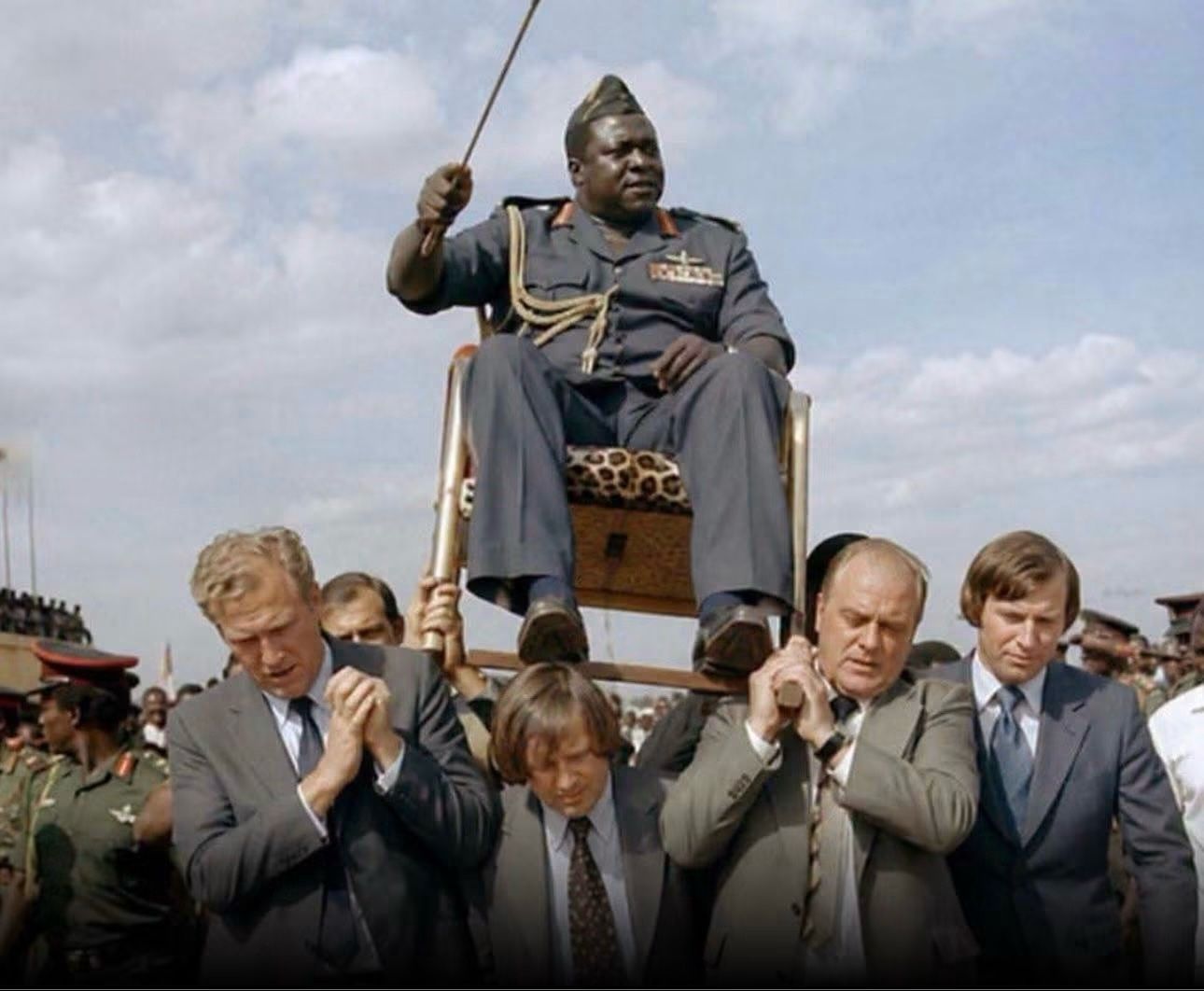
Four British businessmen carry Idi Amin on a raised throne. The gesture looks theatrical, almost absurd. But in the context of the Cold War, nothing was innocent.
Translated from Portuguese. Read the original →

The photograph as a Cold War device
In July 1975, an image left Kampala and went straight into the geopolitical imagination of the twentieth century.
Four British businessmen carry Idi Amin on a raised throne. The gesture looks theatrical, almost absurd. But in the context of the Cold War, nothing was innocent.
The photograph was not only a symbolic humiliation of the former British colonial power. It was also a coded message sent to multiple international actors:
- London
- Washington
- Moscow
- Cairo
- Tripoli
In a world split into ideological blocs, every image could be read as a strategic statement.
Idi Amin understood this better than many diplomats.
Uganda as a “strategic peripheral” state
Uganda held a discreet but highly sensitive geopolitical position.
Located between Sudan, Kenya, Zaire (today’s DRC) and Tanzania, the country was a crossroads of interests:
- trade routes of the African interior
- residual British influence in East Africa
- Soviet expansion through African allies
- Arab–African rivalry (Egypt, Libya, Sudan)
For the CIA and MI6, Uganda was not a centre of global power — but it was a potentially useful point of instability.
In Cold War logic, fragile states could be used as pieces on a strategic chessboard.
Idi Amin’s rise and the Western miscalculation
Idi Amin came to power in 1971 through a military coup against Milton Obote.
The international reaction was surprisingly ambiguous.
- The United Kingdom initially took a pragmatic stance
- Israel provided early military cooperation
- Some Western circles saw Amin as a “stabilising factor” against growing Soviet influence
According to several historical analyses and partially declassified documents, the CIA monitored the coup but did not initially classify it as a direct strategic threat.
The logic was typical of the Cold War:
- authoritarian regimes could be tolerated if they served larger geopolitical interests.
This misjudgement would open the way to an unpredictable escalation.
MI6, the CIA and the politics of “controlled chaos”
The presence of Western secret services in Africa in the 1960s and 1970s is now widely documented, although many operations remain classified.
The general pattern was as follows:
- prevent the collapse of allied states
- stop Soviet advances
- support “functional” leaders, even authoritarian ones
- influence local military elites
In Uganda’s case:
- MI6 kept diplomatic and intelligence contacts with the new regime
- the CIA monitored regional political developments, especially regarding Tanzania and Zaire
- Israel maintained military cooperation with Kampala until the mid-1970s
Yet Idi Amin quickly became too unpredictable for any strategy of outside control.
The radical turn: expelling the Asians and breaking with the West
In 1972, Amin expelled some 80,000 Asians (mainly of Indian and Pakistani origin), many of whom controlled key sectors of the Ugandan economy.
- a clash with the United Kingdom
- a diplomatic crisis with London
- an economic reorganisation of the country
- rising internal instability
The decision was not only ideological. It was also strategic:
- Amin sought to:
- redistribute domestic wealth
- consolidate military support
- break colonial economic dependence
- assert full sovereignty
But the result was the collapse of essential economic networks.
The Cold War reshuffle: Libya, the USSR and Israel
From 1973, Uganda entered a phase of rapid geopolitical reorientation.
1. Libya
Muammar Gaddafi became one of Amin’s main allies.
- financial support
- military cooperation
- shared anti-imperialist rhetoric
2. Soviet Union
- arms supplies
- military training
- diplomatic support in international forums
3. Israel → total rupture
Once Amin’s ally, Israel broke off relations amid growing instability.
The climax would be the Entebbe hostage crisis (1976), when tension between Uganda and Israel reached its peak.
The 1975 photograph as a global geopolitical message
The image of the British carrying Amin should be read as a communication operation with multiple audiences:
To the West:
A warning that colonial influence was over.
To Africa:
A display of symbolic anti-imperial power.
To the Cold War:
A signal that Uganda could swing between blocs.
Amin was not simply an isolated dictator. He was an actor who exploited the structural rivalry between the great powers.
The regime’s internal logic: state, violence and survival
Behind the geopolitical staging lay a brutal domestic reality:
- military purges
- political disappearances
- institutional collapse
- a declining economy
Amin governed through a logic of permanent political survival.
The more isolated he was internationally, the more he depended on internal repression.
The more repressive he was at home, the more isolated he became.
A classic cycle of authoritarian collapse.
The war with Tanzania and the end of the geopolitical equation
In 1978, Amin invaded Tanzania.
The strategic mistake was decisive:
- a complete underestimation of the enemy
- diplomatic isolation
- no consistent outside support
Julius Nyerere’s response turned the conflict into a regional war.
In 1979, the regime collapsed.
No outside power stepped in to save Amin.
Not the United States.
Not the United Kingdom.
Not the USSR.
The Cold War “chess game” abandoned the Ugandan piece.
Conclusion: what the Cold War really reveals in the Amin case
The story of Idi Amin is not just the story of an African dictator.
It is a case study in how the Cold War worked outside Europe:
- weak states as instruments
- local leaders as brokers of influence
- secret services operating through shifting alliances
- ideology subordinated to strategic interests
The 1975 photograph remains a summary of this system.
It shows a man at the centre of a global stage.
But that stage was not his to control.
It was the product of a much larger geopolitical architecture, where power was not only military or economic — it was also symbolic, media-driven and deeply unstable.
In the end, Idi Amin did not only humiliate Britain.
He unwittingly exposed the fragility of the entire post-colonial international system.